Growing
Dragon Fruit (Selenicereus undatus) Guide: Starting Plants, Support, Pollination and Harvest
How to grow white-fleshed dragon fruit from cuttings, build a post it can climb, water and feed it, pollinate the night-blooming flowers, prune it, and harvest the fruit.
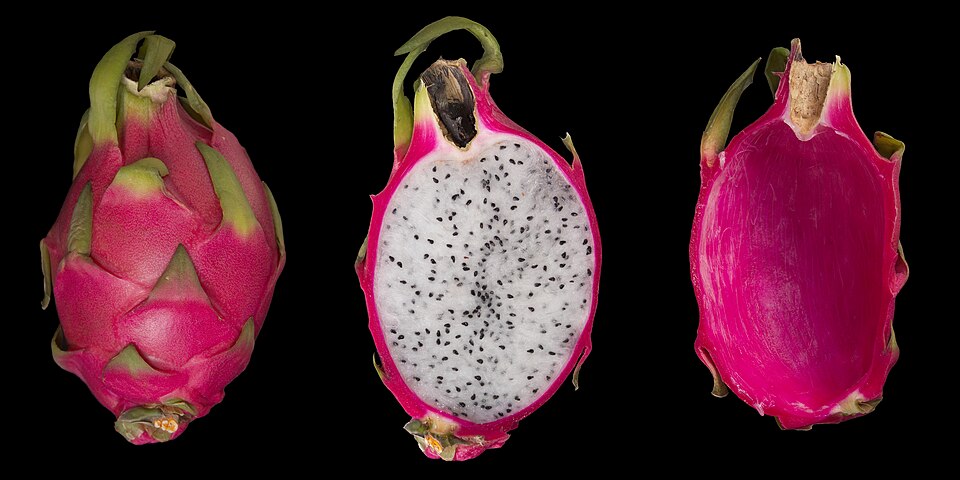
Photograph: 阿橋 HQ, CC BY-SA 2.0. Source: Wikimedia Commons
On this page
Introduction
A dragon fruit plant is a climbing cactus that opens enormous white flowers for a single night and then, a month or so later, hands you a pink fruit the size of your fist or bigger. You root a piece of stem, give it something tall to climb, keep it out of soggy ground, and wait for the buds. Nothing about it is difficult, but almost every step has a number attached that decides whether you get fruit in one year or never.
The plant in this guide is Selenicereus undatus, the common white-fleshed dragon fruit, also sold as pitaya or pitahaya and still listed under its older name Hylocereus undatus in many references. It has pink skin, white flesh and small black seeds. We cover where it can live, how to start it from a cutting, what kind of post to build, how to water and feed it, how the night-blooming flowers are pollinated, how to prune it, how to know when a fruit is ready, and what the plant does and does not offer beyond the fruit itself.
Summary
- Climate: it grows outdoors in USDA zones 10 to 11, grows best at 18 to 25 °C (65 to 77 °F) (18 to 25 °C), and is damaged by a long freeze below -1 °C (31 °F) (-2 °C).
- Light and soil: full sun, at least 6 hours a day, in well-drained soil with a pH between 5.3 and 6.7.
- Start it: from a cutting 6 to 15 inches (12 to 38 cm) long, cured for 7 to 8 days. A cutting can fruit 6 to 9 months after planting, while seed can take up to 7 years.
- Support it: a sturdy post 4 to 6 inches thick with a metal frame on top, because a mature plant weighs several hundred pounds.
- Pollinate it: grow two or three different plants and move pollen by hand at night or in the early morning.
- Harvest: about 30 to 50 days after the flower opens, when the skin has full color.
Why does a cactus need so much help from you? Because in a garden it faces conditions its wild ancestors never did, such as a fixed row, a single clone with no partner for pollen, and a sprinkler that waters it every night.
The sections below follow the plant from the first cutting to the last fruit, and they finish with the cautions you should know before you eat or handle it.
Plant Biology and Growth Habit
The plant
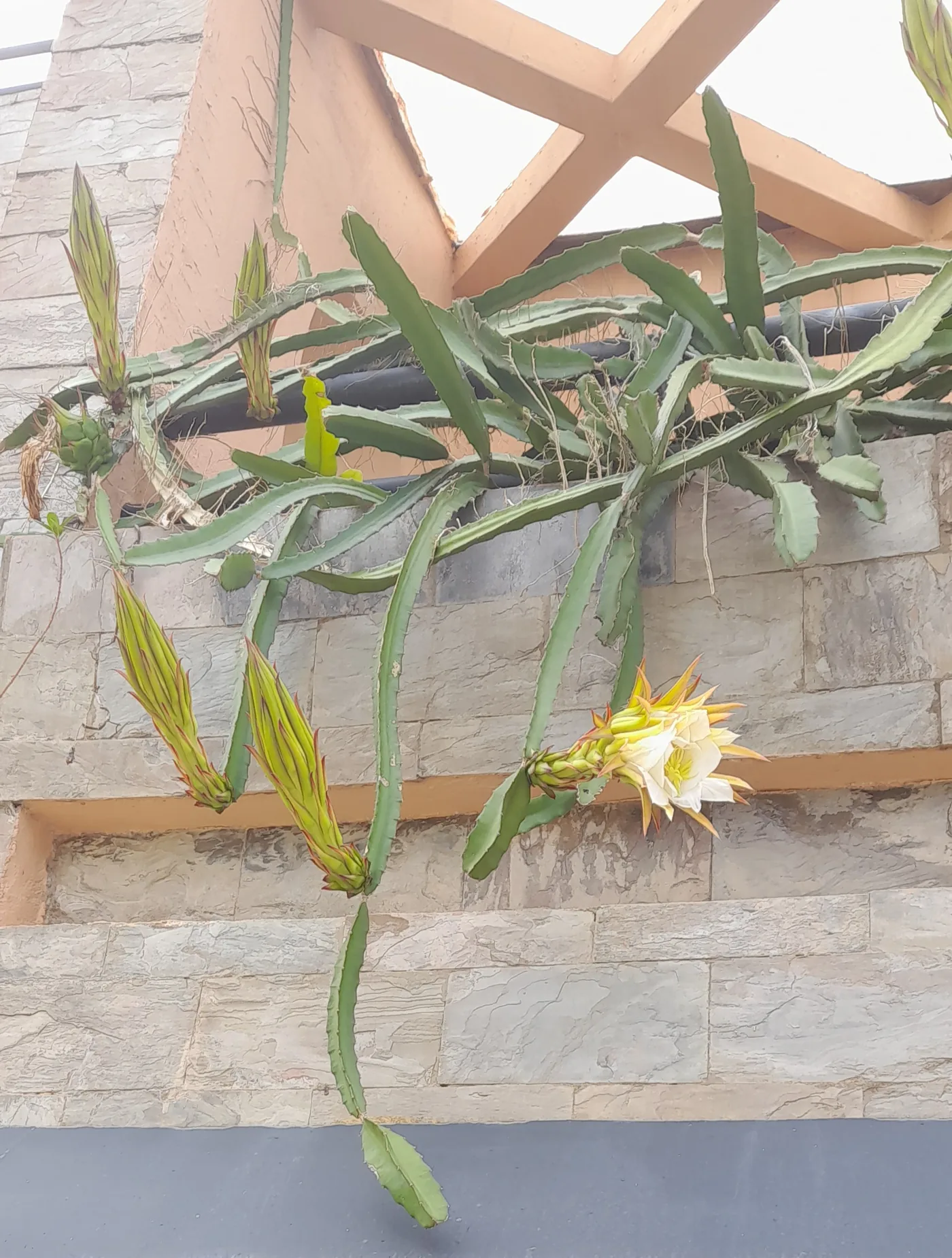
This is a perennial, drought-resistant cactus. Where is the trunk? There is none, and there are no leaves in the usual sense. What you see are long, green, three-winged stems with scalloped edges that climb by sending out small roots from the stem itself, and the stems can reach 33 feet (10 m) in length. Each stem is 1 to 2 inches wide, and short gray-brown spines up to 0.4 inch (1 cm) long sit along the edges.
On a post, a plant normally stands 8 to 20 feet tall and 3 to 10 feet wide, and its growth rate is rapid. Once the stems reach the top of their support they arch over and hang down, and the hanging stems are the ones that flower and fruit.
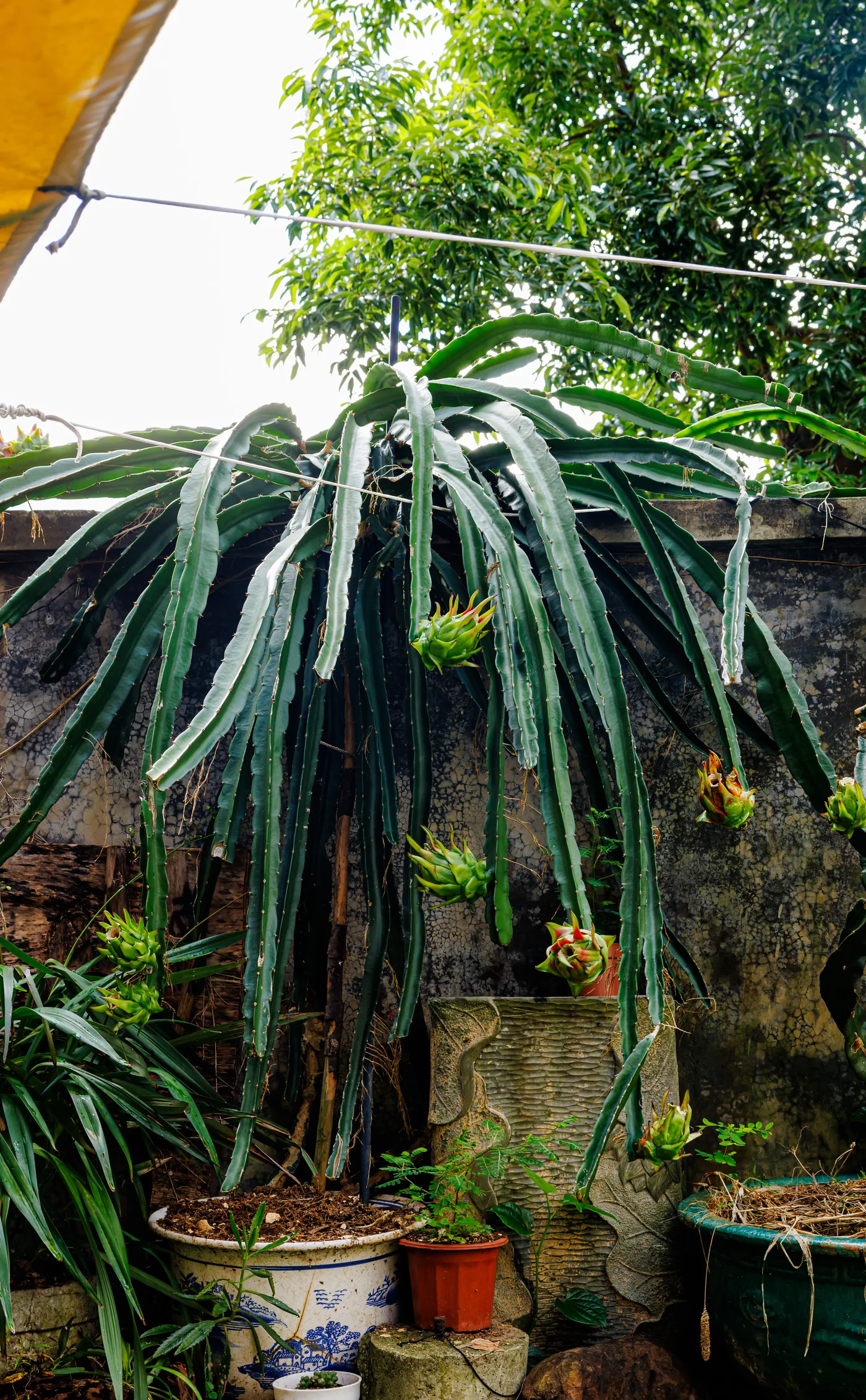
Size is the first thing to plan for, because a plant that looks small in a pot grows into a large, heavy structure.
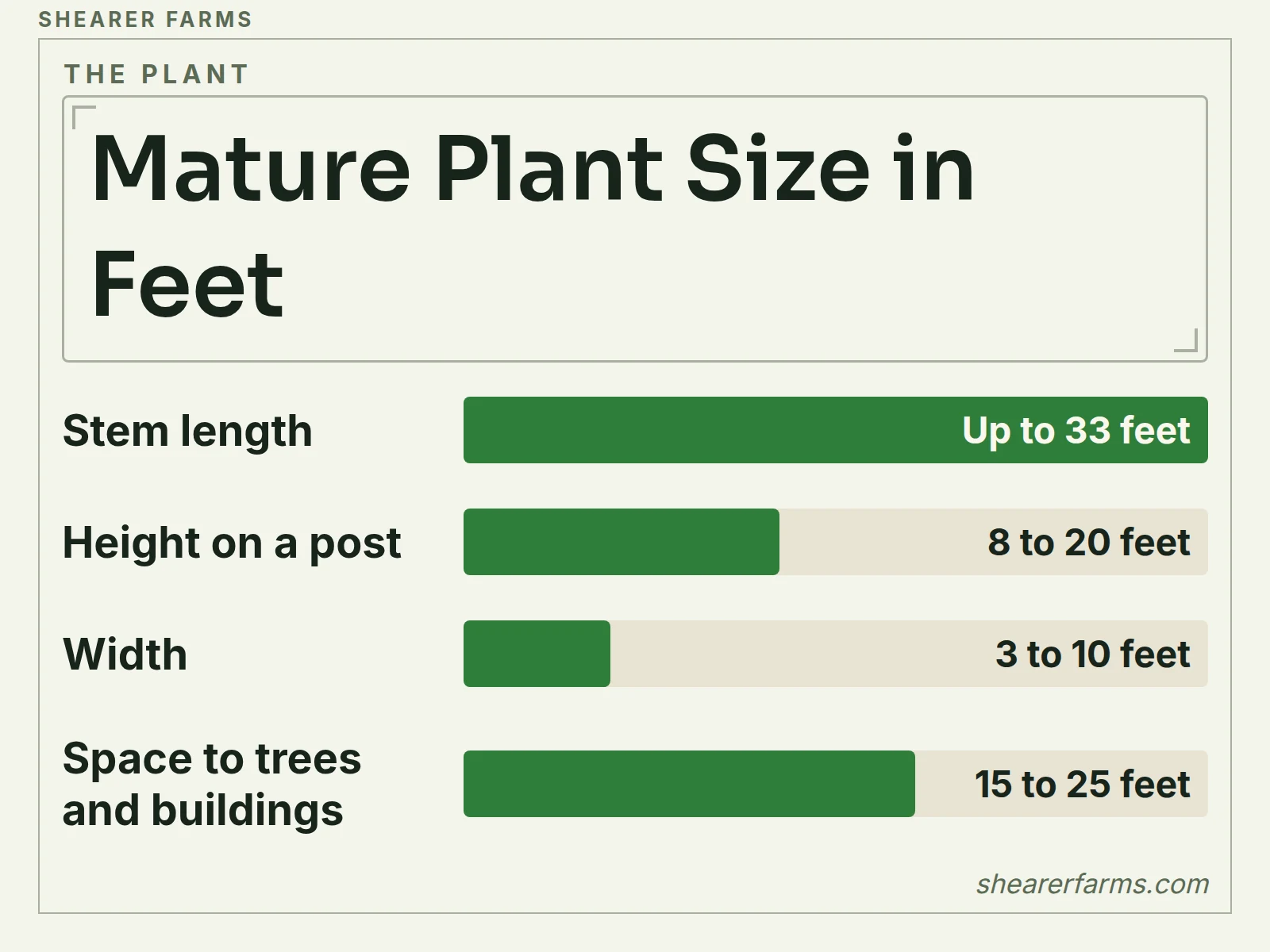
The bars use the middle of each range except stem length, which is the maximum, and the distance from buildings, which is the range quoted for a home planting. Plan on 15 to 25 feet (4.5 to 6.1 m) between a plant and the nearest tree, building or power line.
The flower and the fruit
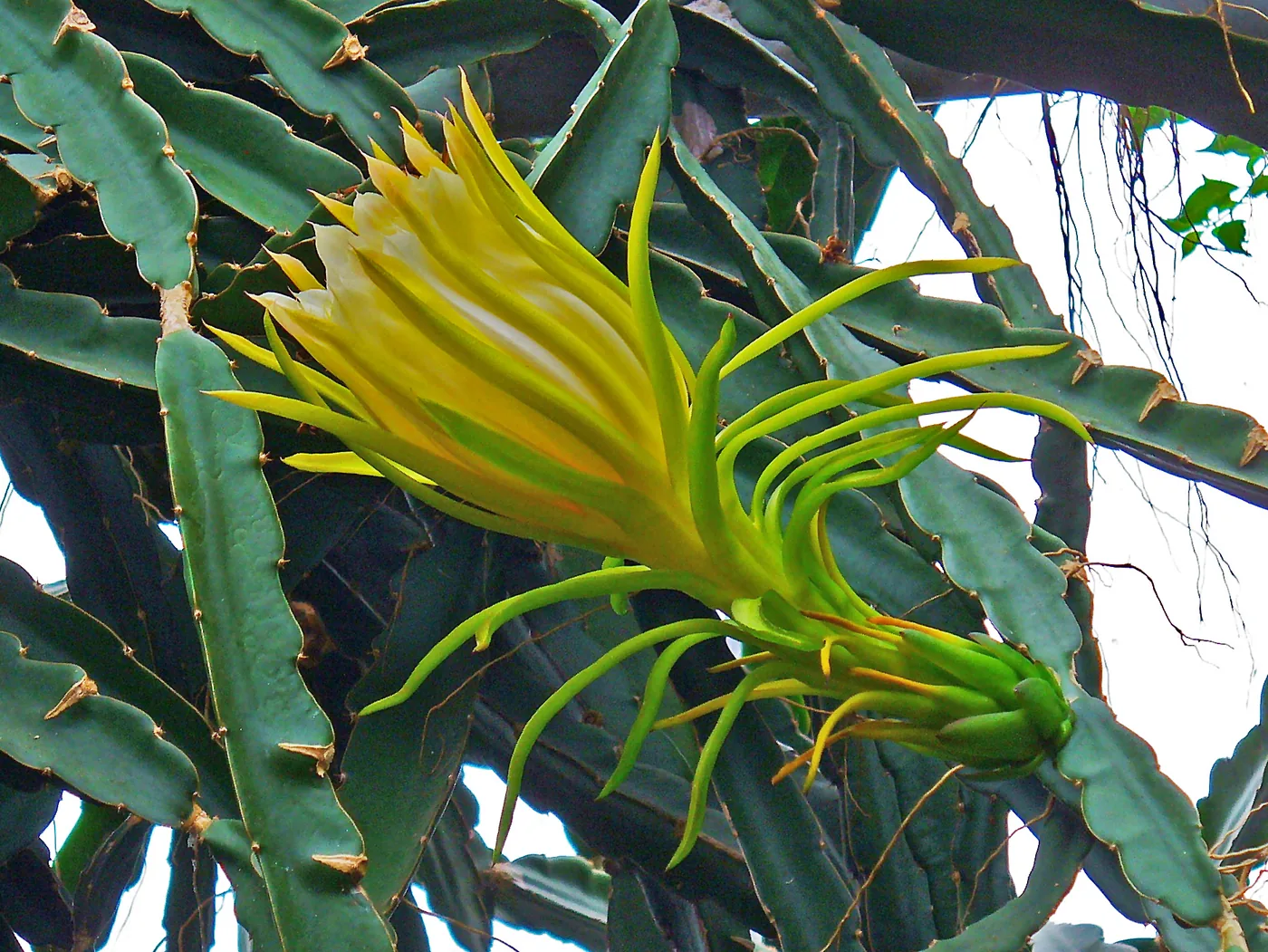
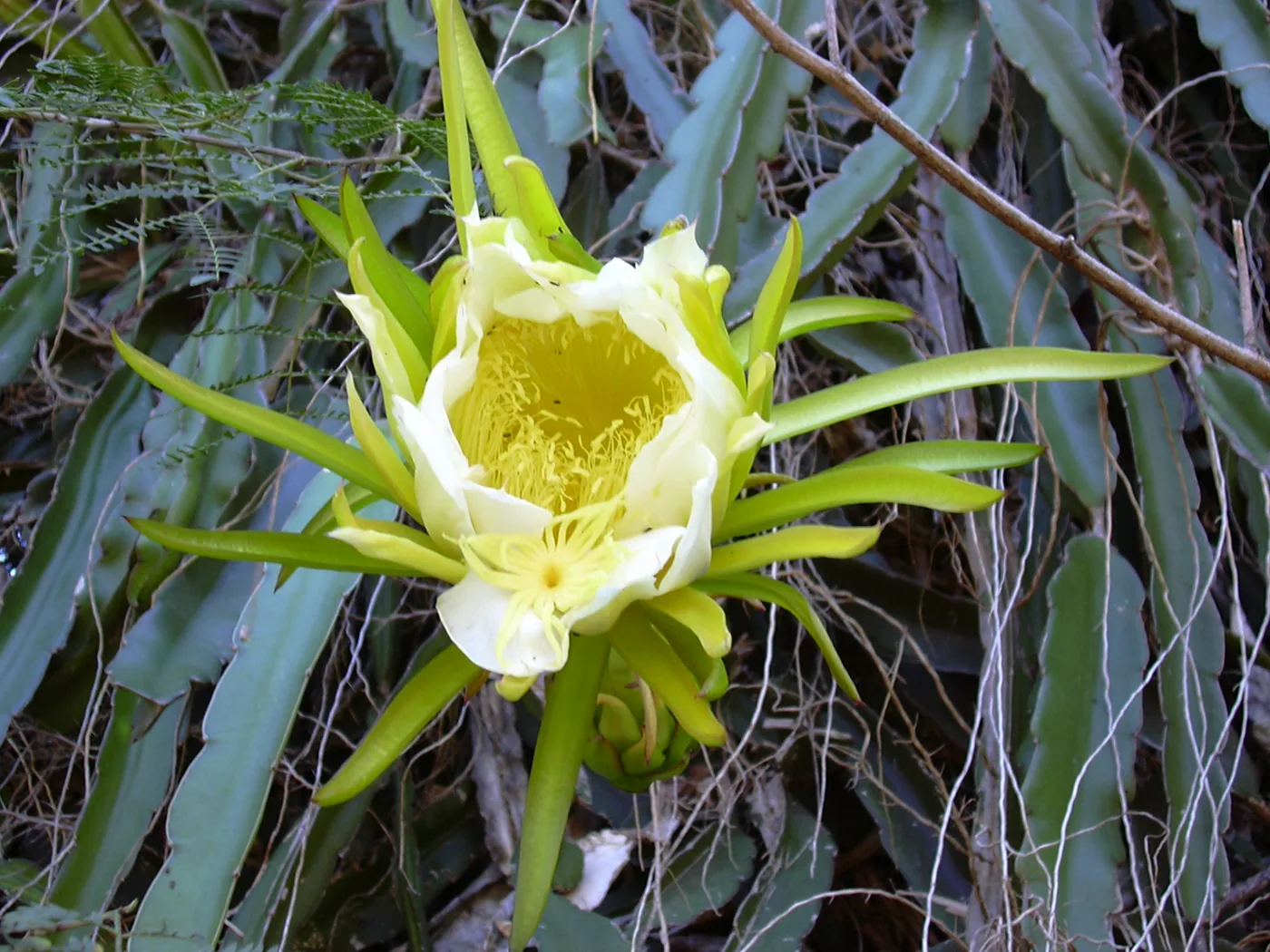
The flower is the part that surprises people. It opens at night. It lasts one night. It is fragrant, and it can reach 14 inches (36 cm) long. The petals are white, the outer segments are green, and a ring of yellow stamens sits in the middle. Flowers appear from late spring through summer, and a mature plant often produces 4 to 6 fruiting cycles a year.
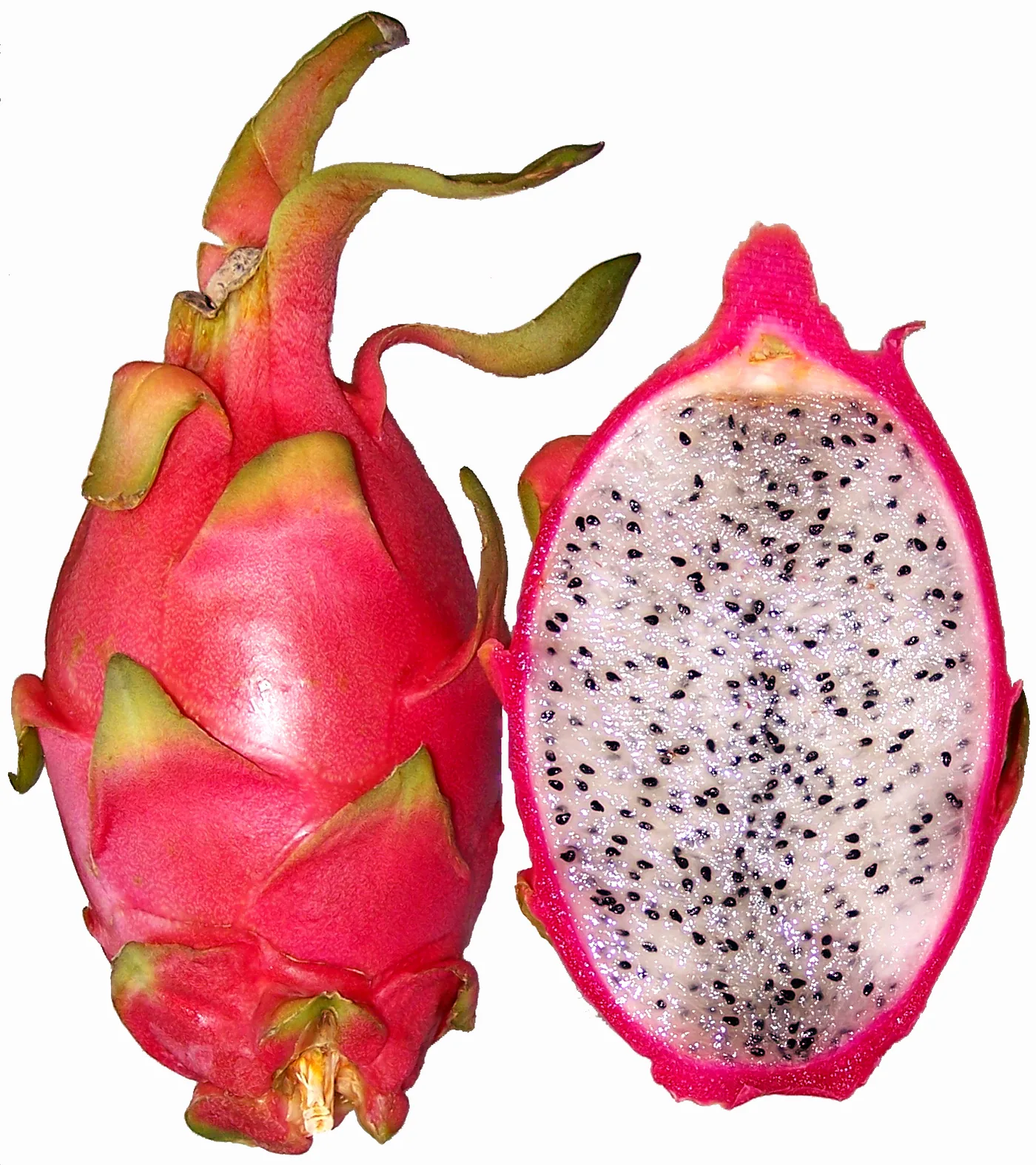
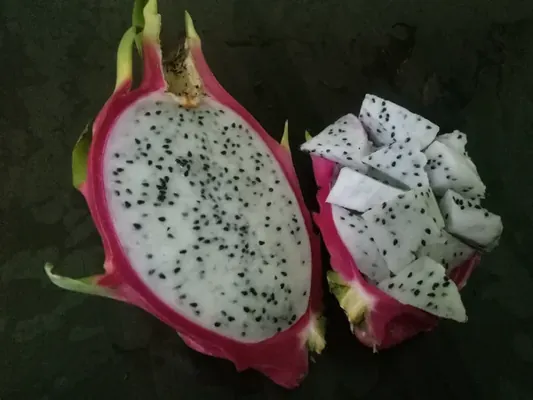
The fruit is a berry. It is oval to oblong, 4 to 6 inches (10 to 15 cm) long, and usually weighs between 0.5 and 3 pounds. The skin is pink with scale-like green tips, the flesh is white, and it holds many small black seeds that you eat with the pulp. Fruit weights quoted for the species run from about 150 g to 600 g, with some reaching 1 kg.
White flesh and red flesh
Three kinds are common in gardens. Selenicereus undatus has pink skin and white flesh. Selenicereus costaricensis has red skin and red flesh. Selenicereus megalanthus has yellow skin and white flesh.
| Type | Skin | Flesh |
|---|---|---|
| Selenicereus undatus | Pink | White, the most common type |
| Selenicereus costaricensis | Red | Red |
| Selenicereus megalanthus | Yellow | White |
The red and purple color in the red-fleshed types comes from betacyanins, the same pigment that colors beets. The white-fleshed fruit in this guide has far less of it in the pulp, a point that matters when you read our extraction guide on the partner website.
Where it comes from
The species is native to southern Mexico and the Pacific coast of Central America, and in the last century or so it has been planted widely across the tropical and subtropical regions of Asia and the Americas. In some places it spreads from gardens into the wild and is classed as an invasive weed, so check with your local extension office before you plant it outdoors in USDA zones 10 to 11.
The Conditions It Wants
Climate and light
This plant belongs in warm, bright places. It is rated for USDA hardiness zones 10 to 11, and it may survive outdoors in zone 9 if you give it protection. It tolerates heat up to about 100 °F (38 °C), and it grows best between 65 and 25 °C (77 °F) (18 to 25 °C).
At what temperature does damage start? A long freeze below -1 °C (31 °F) (-2 °C) damages the stems, although a light freeze injures them only briefly and plants recover quickly. A short frost is survivable. A long, hard freeze is not, and that is why the plant is a container crop where winter lows fall below -1 °C (31 °F) (-2 °C).
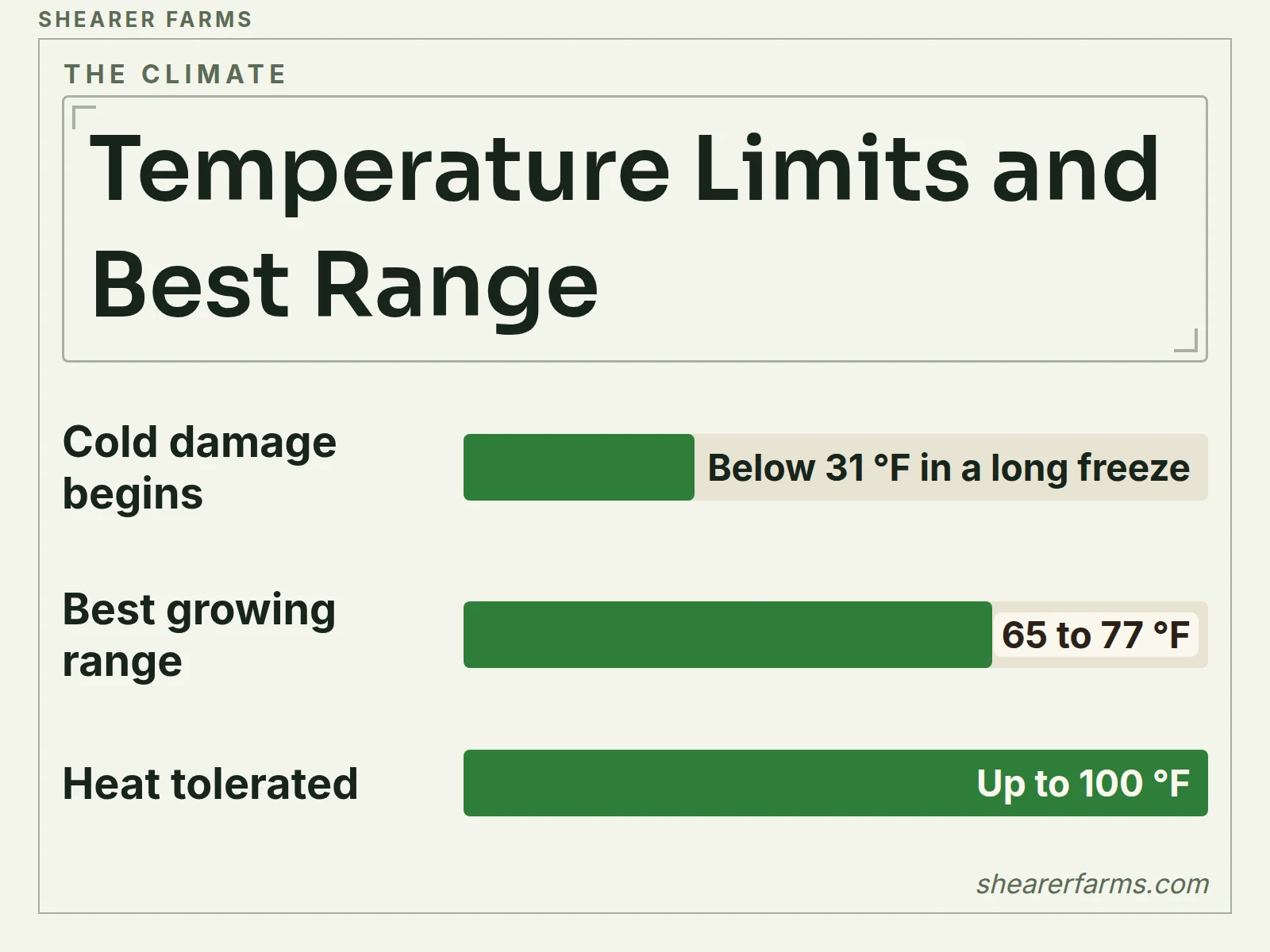
The bars use the middle of the best range. Notice how narrow the comfortable zone is compared with the stretch between damage and scorching heat, and treat the cold figure as the one that cannot be argued with.
Light needs to be high as well. The plant wants full sun, at least 6 hours of direct light a day, and it tolerates some shade. Fewer than 6 hours of direct light lowers both yield and fruit quality, while unshaded sun in dry, high-elevation air scorches the stems. In that situation, 30 percent shade cloth for the first 3 to 4 months after planting protects young cuttings without starving them.
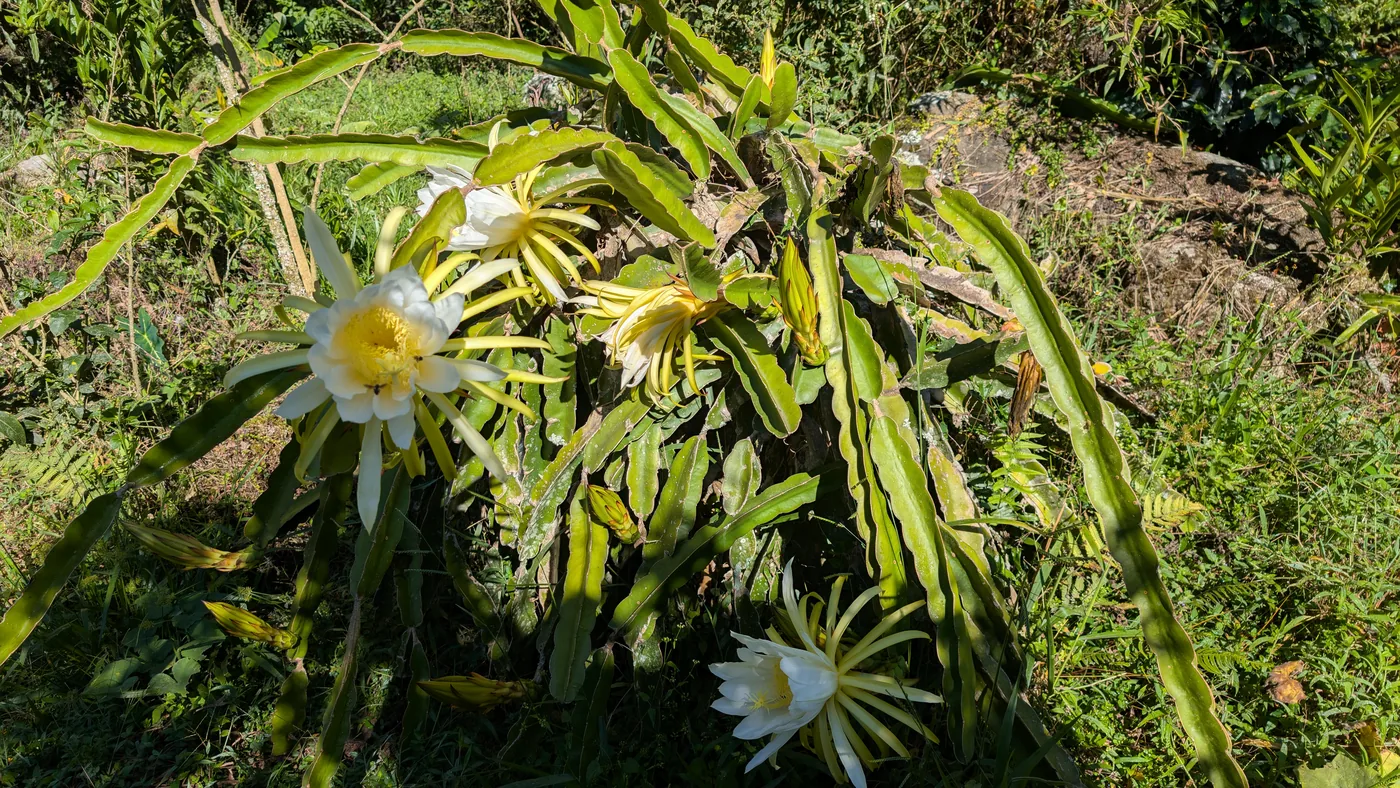
Light and warmth set the limits, and the soil decides how well the roots live within them.
Soil and pH
Soil texture matters less than drainage. The plant grows in sand, loam or clay as long as water drains away, and it tolerates poor soil. It hates wet roots. Overwatering and heavy rain bring on stem rot and root rot.
| Requirement | What the sources say |
|---|---|
| USDA hardiness zones | 10 to 11 outdoors |
| Best temperature | 18 to 25 °C (65 to 77 °F) (18 to 25 °C) |
| Heat tolerated | Up to 100 °F (38 °C) |
| Cold damage | A long freeze below -1 °C (31 °F) (-2 °C) |
| Light | Full sun, 6 or more hours a day |
| Soil | Sand, loam or clay, well drained |
| Soil pH | 5.3 to 6.7 preferred, 5 to 7.5 tolerated |
| Rainfall tolerated | 300 to 3,500 mm a year |
| Elevation | Up to 2,000 m |
A preferred pH of 5.3 to 6.7 puts it in mildly acidic to neutral ground, and you can check your own with an inexpensive test kit before you plant. If your water table sits within 7 feet of the surface, or the ground floods, build a mound 2 to 3 feet (0.6 to 0.9 m) high and 4 to 10 feet (1.2 to 3.1 m) across and plant on top of it.
Choosing a site
Choose the brightest spot you have, with drainage you can trust. Keep the post 10 to 15 feet from other plants and structures, and keep the plant itself 15 to 25 feet from trees and power lines, because a mature plant is large and heavy. Avoid a place where strong wind or a storm can reach the support, since high winds are the main thing that destroys trellises.
Think about the lawn too. Keep turf 2 to 5 feet (0.6 to 1.5 m) from the plant, never run a mower or a string trimmer close to the stem, and stay away from herbicide near the base. Heavy lawn fertilizer near the roots can lower yield and fruit quality.
Variants Worth Growing
A grower asks three things before buying a plant: which one gives the most fruit, which one holds the most of the compounds people want from the fruit, and which one takes the cold best. The best figures we found come from a variety evaluation chart of about 20 types grown in Southern California, and its numbers are for that place and that trial, so read them as a ranking and not a promise.
| Question | Variant | Why |
|---|---|---|
| Top Yielding | Physical Graffiti, a red-skinned type from Florida | It gave 23,429 g of market fruit per plant in the Southern California trial, the highest of the 20 listed. Among the pink-skinned, white-fleshed types like the one this guide grows, Mexicana gave 9,165 g and Bien Hoa White 7,394 g. |
| Highest In betalains | The red-fleshed types, Selenicereus costaricensis and Selenicereus polyrhizus | A review of the color literature reports more than 800 times the betacyanins in red pulp than in white pulp, and more than 5 times in red peel than in white peel. The review gives no units for the ratios. |
| Hardiest | Valdivia Roja, a red-skinned, red-fleshed type from Mexico | It scored 5 on the chart's cold hardiness scale of 1 to 5, ahead of Halley's Comet and Physical Graffiti at 4.5. The score is a trial rating and not a freeze test, so protect it below 31 °F (-2 °C) like any other. |
| Sweetest | Yellow pitaya, Selenicereus megalanthus | It had the highest sugar reading on the chart, 21.15 Brix, but it took 150 to 180 days to harvest and gave no fruit in that trial. |
If you grow only one, grow a type that suits your cold and your goal. For fruit to eat, choose a high-yielding type. For a pigment extract, choose a red-fleshed type, because the white-fleshed fruit in this guide holds far less of it in the pulp. Buy a rooted cutting of a named type so you know what you planted.
Complete chamomile cultivation guide covering German chamomile botany, self-seeding strategies, apigenin and bisabolol chemistry.
For a More In-Depth Read, Click HereGrowing For Fruit and Cuttings
This plant is grown for two different crops, the fruit and the stem cuttings that make new plants, and the work that raises one is not the same as the work that raises the other. Both start with a plant that is strong and in the right place.
Sun, water and feed. Fruit follows light, so give the plant full sun, at least 6 hours a day, and well-drained soil. Water at least once a week through flowering and fruiting, hold water back in winter, because a dry period helps flowering, and feed on the schedule in the water and feeding section.
Spacing and support. A crowded plant shades its own stems, and shaded stems carry little fruit. Give each plant its own post, keep plants 15 to 25 feet apart, and keep the canopy open so air and light reach every stem.
Pruning and training. The hanging stems are the ones that flower, so tip the leader at the top of the post to make it branch and drape. Prune 1 to 3 times a year once the harvest ends, taking out dead, diseased and ground-touching stems.
Pollination and harvest timing. Pollinate by hand at night, and use 2 or 3 genetically different plants, because a cross with a different plant is the dependable route to fruit. Harvest ripe fruit about 30 to 50 days after the flower opens, once the skin is fully colored.
Cuttings. A cutting is a clone of its parent, so take cuttings from the plant whose fruit you want to repeat. Use healthy stem pieces 6 to 15 inches long, cure them 7 to 14 days in dry shade, and pot them for 4 to 6 months. A cutting often fruits 6 to 9 months after planting.
If you want cuttings more than fruit, the advice changes. Prune harder when the harvest ends and keep the healthy stems for cuttings, and let the plant spend less on fruit. If you want seed instead, let fruit ripen fully and sow the seed shallow, but a seedling can take up to 7 years to fruit and will not match its parent.
Starting Your Plants
Cuttings are the way to start
You can grow it from seed, which germinates in 11 to 14 days after shallow planting, but a seedling can take up to 7 years to fruit. A cutting is far faster. Many cuttings produce fruit 6 to 9 months after planting, and the plant is a copy of the parent, so you know what you are getting.
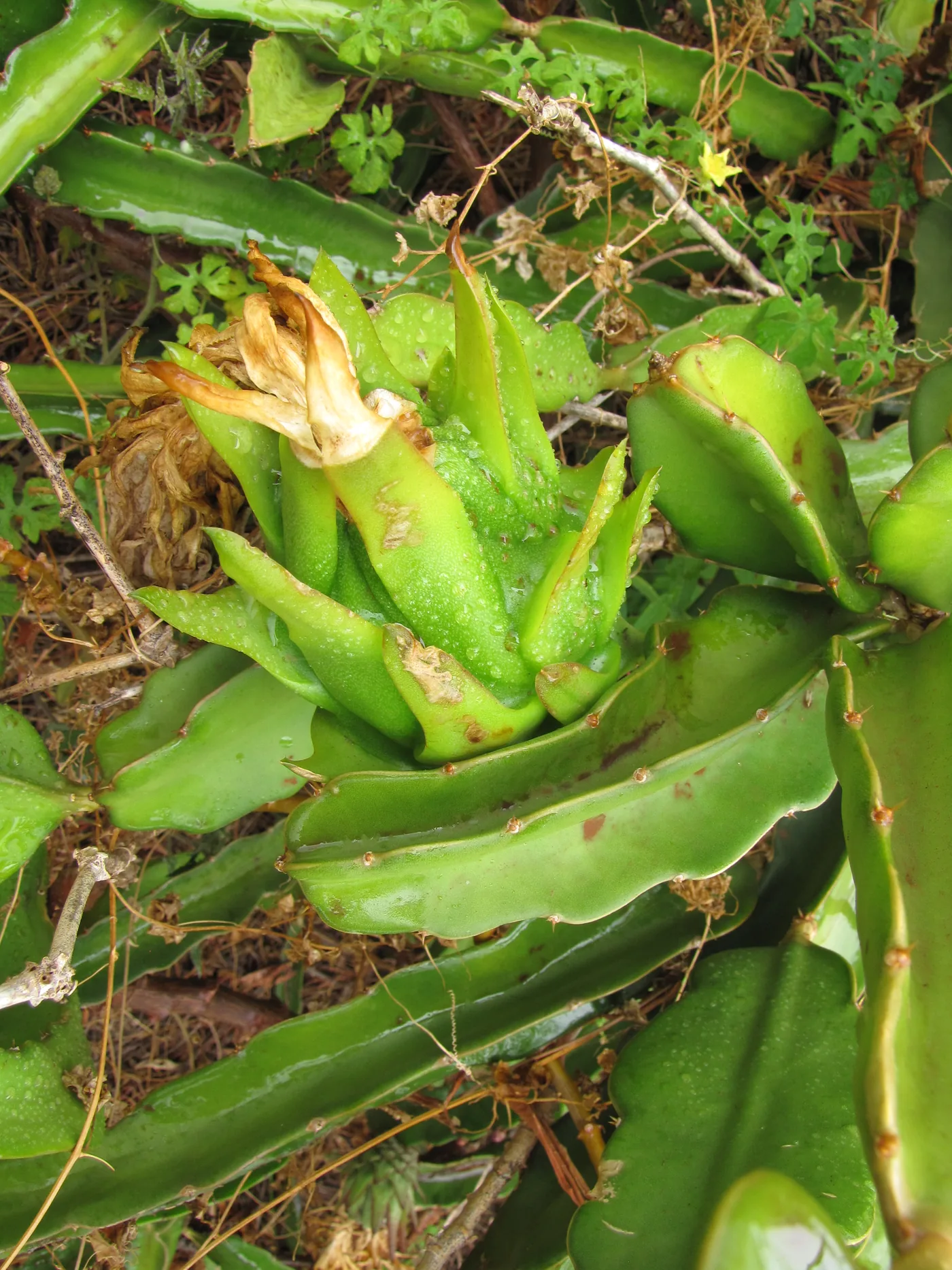
A good cutting is a healthy stem piece 6 to 15 inches (12 to 38 cm) long. Longer cuttings reach the trellis faster, so choose the long end of that range if you can. Here is the method, step by step.
- Cut the stem at a slant and treat the cut with a fungicide.
- Cure it, which means leaving it in a dry, shaded place for 7 to 8 days so the cut dries and seals. Another source gives 1 to 2 weeks, so treat the range as 7 to 14 days.
- If you like, dip the cured end in rooting hormone. It is not required, though some growers use it.
- Plant the cutting in well-drained soil or a pot of cactus mix, and keep it out of standing water.
- Keep a potted cutting for 4 to 6 months, until it has a good root system, before it goes in the ground.
After rooting, growth is quick. A healthy cutting can add about 1.2 inches (3 cm) a day, so a tall post is not an exaggeration.
Planting day
Dig a hole 3 to 4 times the width of the pot, and clear the turf from an area 3 to 10 feet (0.9 to 3.1 m) across. On rocky ground you may need a heavy bar. Mix organic matter or well-decomposed manure into the backfill, and set the plant at the same depth it grew at before.
How far apart should the plants stand in a row? Space them 15 to 25 feet (4.5 to 7.6 m) apart on a home plot. Commercial plantings, which grow the crop in bulk, run 1,100 to 1,350 plants per hectare, and a plant can take up to 60 months to reach full production.
Support and Training
Will the plant stand on its own? No. A mature plant needs a support that holds several hundred pounds of stem weight for years. That is the main reason the post matters more than the plant when you plan a garden.
Building the post
Use a pressure-treated post 4 to 6 inches (10 to 15 cm) in diameter and set it deep and firm. Put a sturdy metal grid on top, for example a frame of rebar, so the stems have something to climb onto and arch over. A post of that size can carry 1 to 4 plants depending on its thickness.
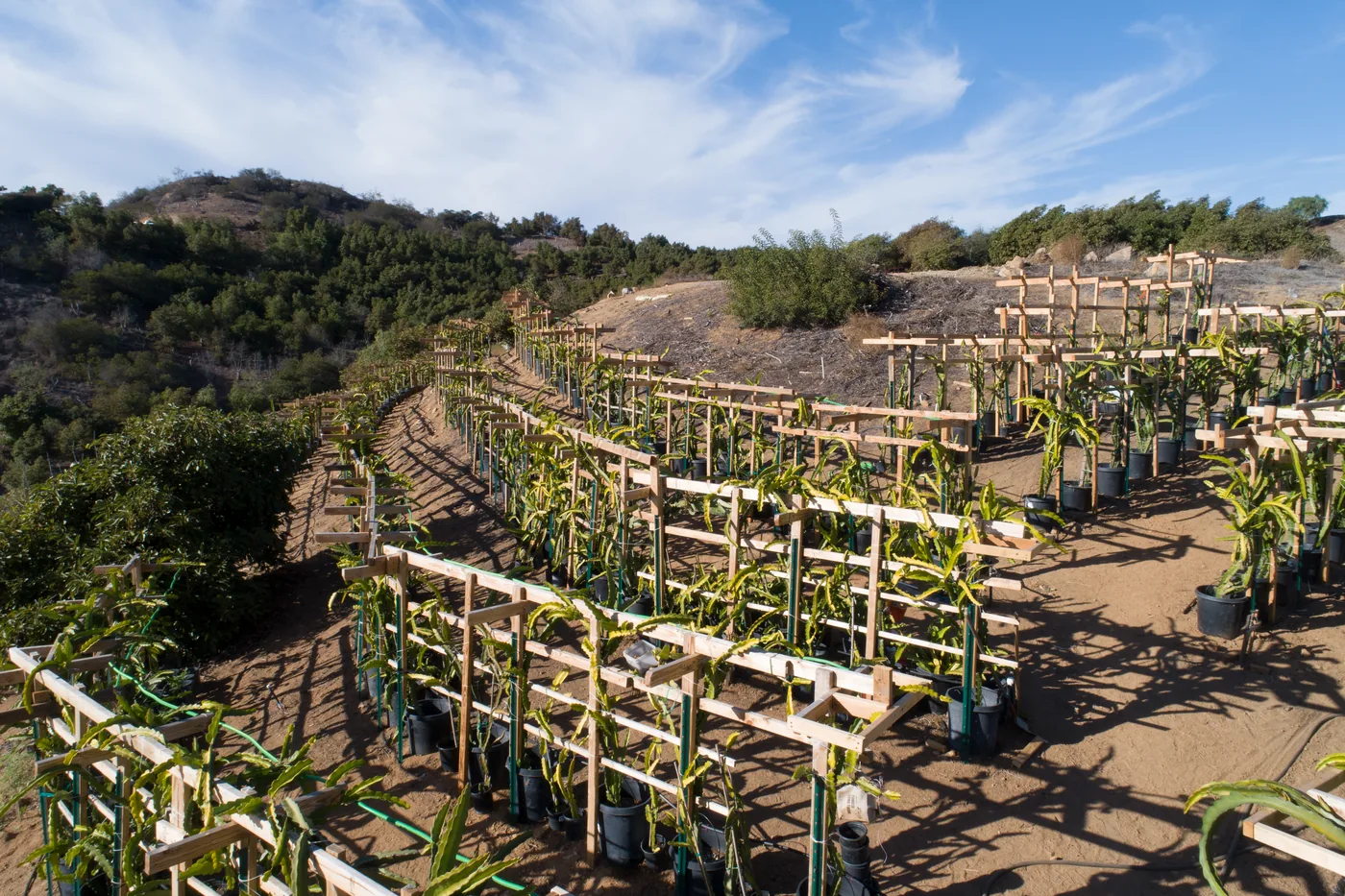
Never use bare cable or wire against the stems, because it cuts them. If you have to use cable, cover it with a length of plastic hose first.
Training the stem
Train one strong leader straight up the post and tie it loosely as it climbs. While the leader is still climbing, remove side shoots along its length, because they steal growth from the stem you want at the top. Tie stems during midday, when they are flexible and less likely to snap.
Once the leader reaches the top grid, cut its tip. Tip removal makes the stem branch, and the new branches droop over the frame and hang down. The hanging stems are the ones that flower and set fruit.
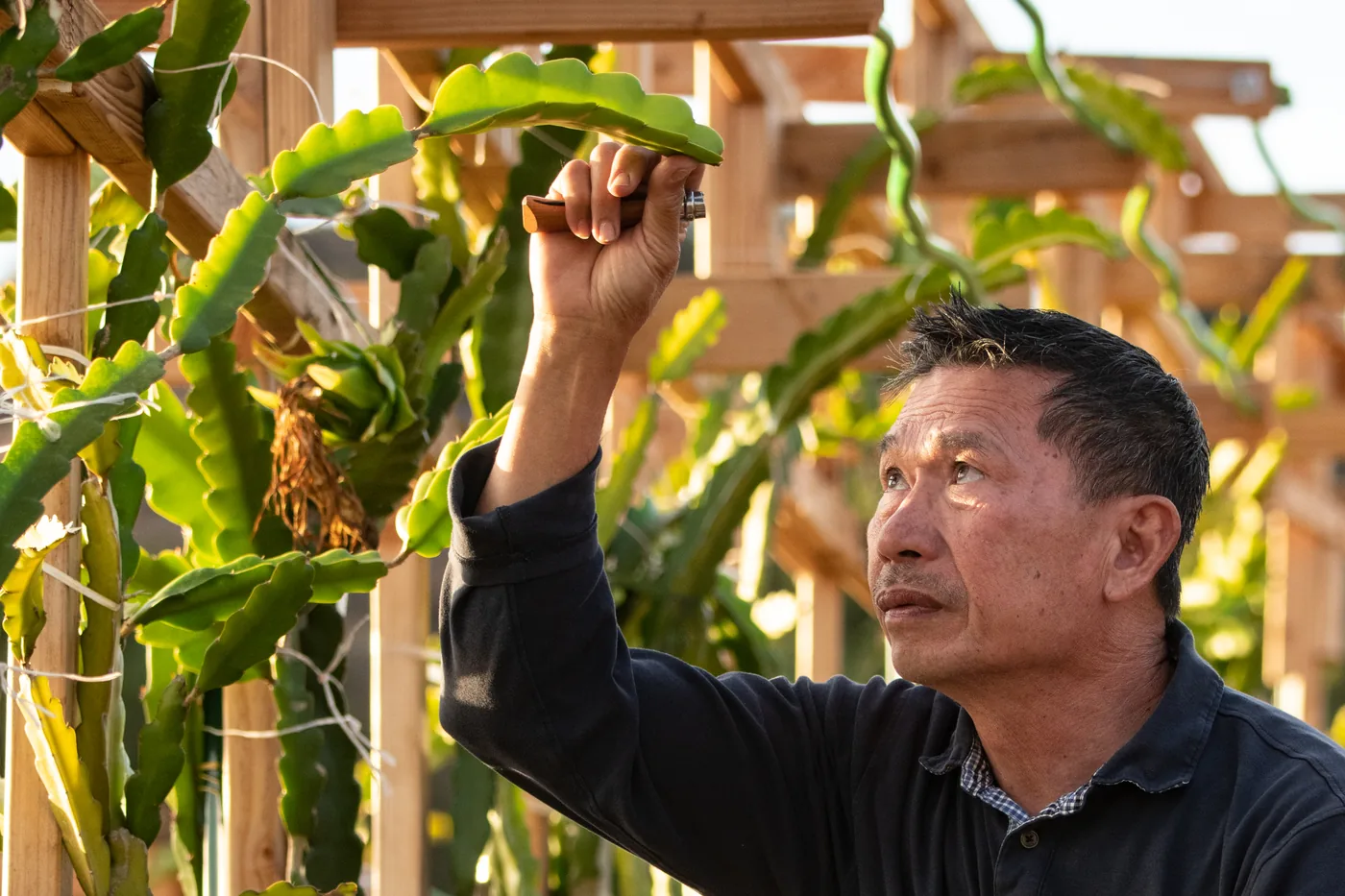
From that point on, your job is to keep the canopy open, with light and air reaching every stem.
Water and Feeding
Water
Does a cactus need regular water? This one does, because it is not a desert plant that wants to be left alone. Water the plant when the soil is almost completely dry, and water generously in spring and summer through the end of flowering. Irrigate at least once a week during flowering and fruiting, since the fruit is mostly water.
In winter and early spring, hold back. A dry period in winter encourages abundant flowering, though the soil should not dry out completely. Outside flowering season, irrigate during long droughts only. Frequent sprinkler irrigation is a mistake because excess moisture brings on bacterial and fungal disease, flower drop and fruit rot.
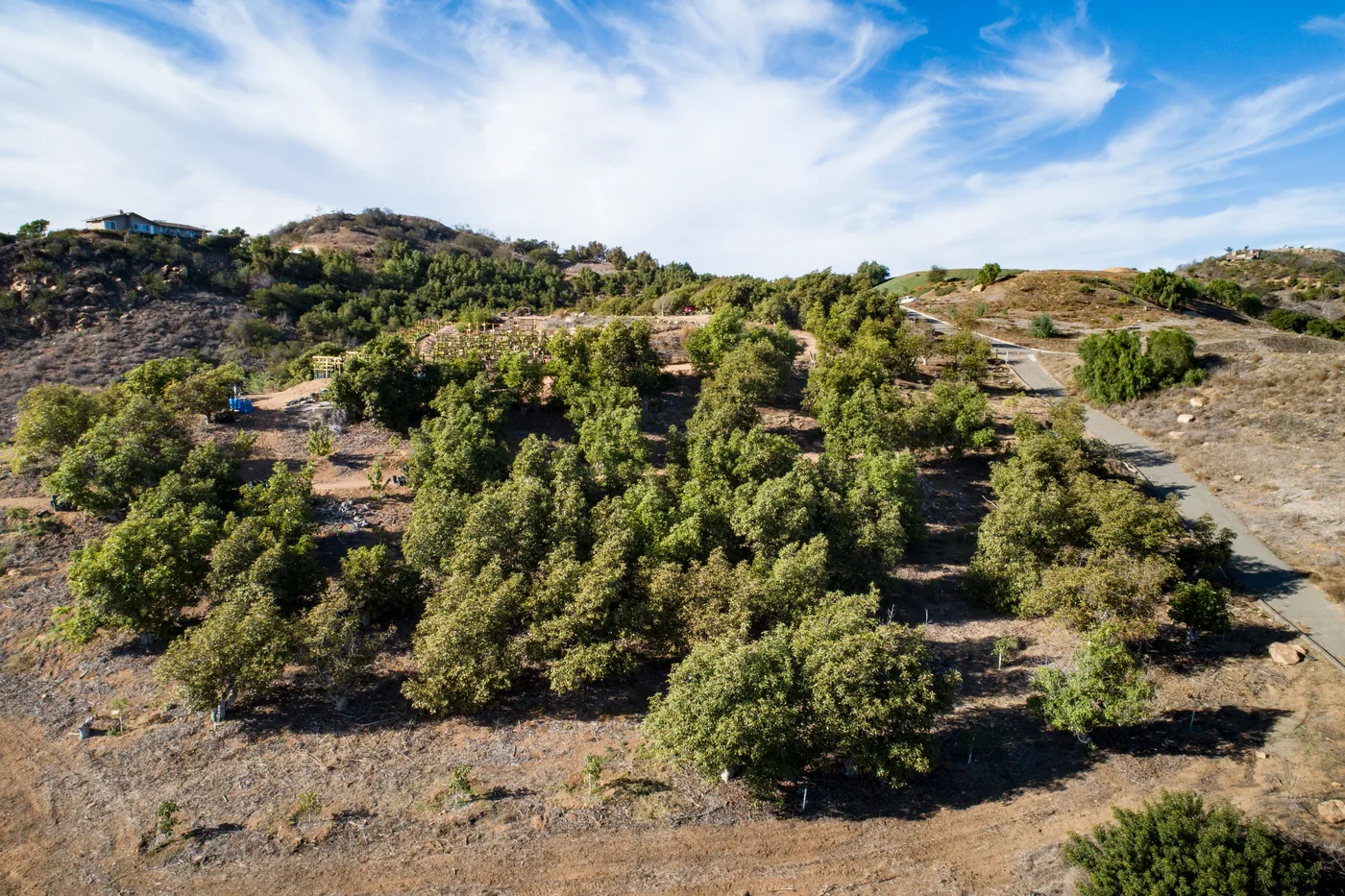
Open ground around each base also helps the stems dry after rain, which matters as much as the amount you apply.
Feeding
Start feeding about a month after planting, or when you see new growth, and fertilize only during the growing season. Fertilizer rates rise as the plant matures, and compost goes on top of the soil, away from the stem.
| Plant age | Fertilizer per plant | Compost |
|---|---|---|
| Year 1 | About 0.25 lb every 2 months | 4 lb (1.2 kg) |
| Years 2 to 3 | 0.3 to 0.4 lb every 2 months | About 6 lb (2.7 kg) |
| Year 4 and later | 0.5 to 0.75 lb, 3 to 4 times a year | 5 lb (2.2 kg) twice a year |
Suitable fertilizer ratios include 6-6-6, 8-3-9 and 8-4-12, each with 2 to 3 percent magnesium. Four to six sprays of minor elements between late March and September round out the program. In high-pH soils, add chelated iron, and in neutral or low-pH soils, a small amount of ferrous sulfate.
Mulch helps too. Spread 2 to 6 inches (5 to 15 cm) of bark or wood chips, and keep the mulch 8 to 12 inches (20 to 30 cm) from the base of the stem so the stem stays dry.
Flowers and Pollination
The night the flower opens
A flower stem usually forms 3 to 5 buds. Two or three of them develop into flowers in about 13 days, and a bud reaches about 11 inches (28 cm) at 16 to 17 days before it opens. Opening starts around 6:40 to 7:00 in the evening and finishes by about 10:00 p.m. The flower begins to wilt around 2:00 a.m., so the window for pollen is only about 7 hours long, from 7:00 p.m. to 2:00 a.m.
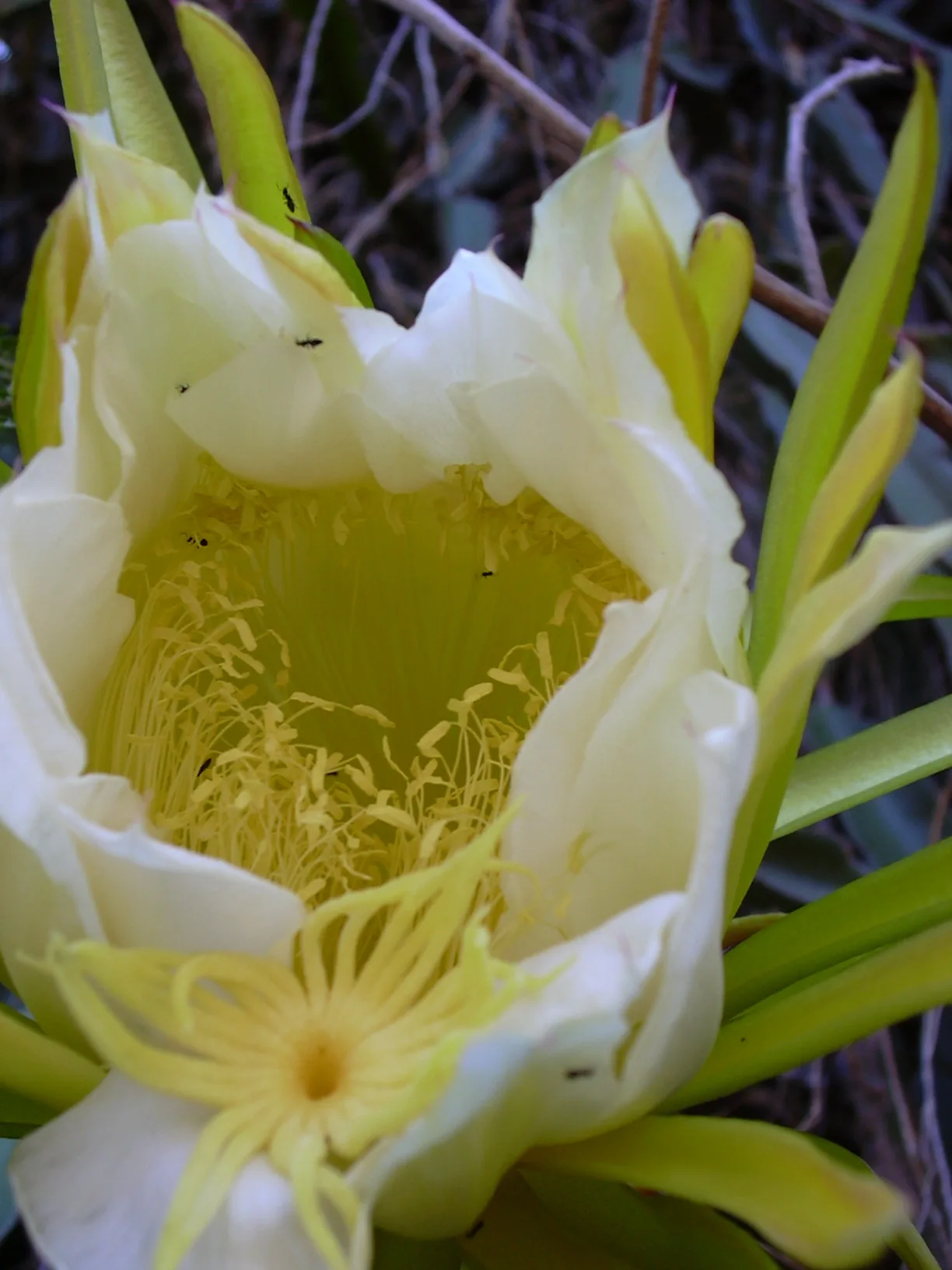
Because the window is that short, do the work at night or in the early morning.
Why you need more than one plant
Do you need a second plant? Yes, because some cultivars cannot fertilize themselves. Moths and bats can pollinate the flowers, but that is rarely seen, and some varieties stay open into mid-morning so bees can visit. For a home garden, the reliable plan is to grow 2 or 3 different genetic types, not clones of one variety, and to pollinate by hand. One of the sources also notes that cross-pollination with a genetically distinct plant generally raises fruit set and quality, even in varieties that are self-fertile.
To pollinate by hand, collect pollen or whole stamens from one flower with a small brush at night or in the early morning, and press it onto the stigma of a flower on a different plant. The stigma is the tip at the center of the flower that receives the pollen. Do this on every flower you want to turn into fruit.
How long each stage takes
Once pollinated, the fruit grows quickly. It reaches ripeness about 30 to 50 days after the flower opens, and a plant can produce more than 50 fruits in a season.
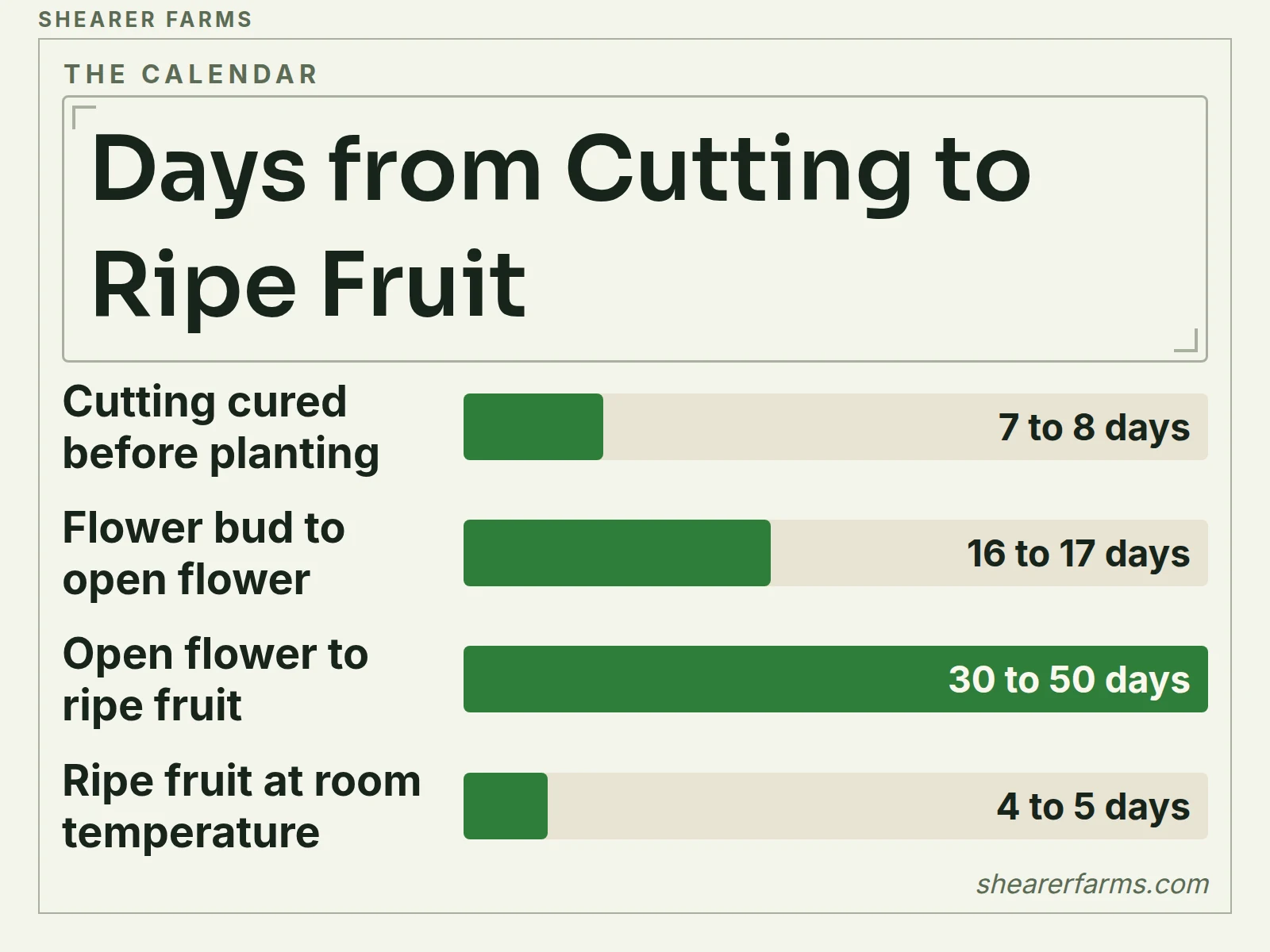
The bars use the middle of each range. Keep the stage times in mind when you plan your watering, because a plant carrying fruit needs steady water right up to the harvest.
Pruning, Pests and Disease
Pruning
How often should you prune? Prune 1 to 3 times a year, ideally once the harvest ends. Cut out damaged, diseased or dead stems, and any stem that reaches the ground. Selective removal also improves vigor and promotes flowering.
Dip each cut in fungicide to cut down on stem rot, use clean tools, and carry the pruned stems out of the planting area. Compost them away from your plants.
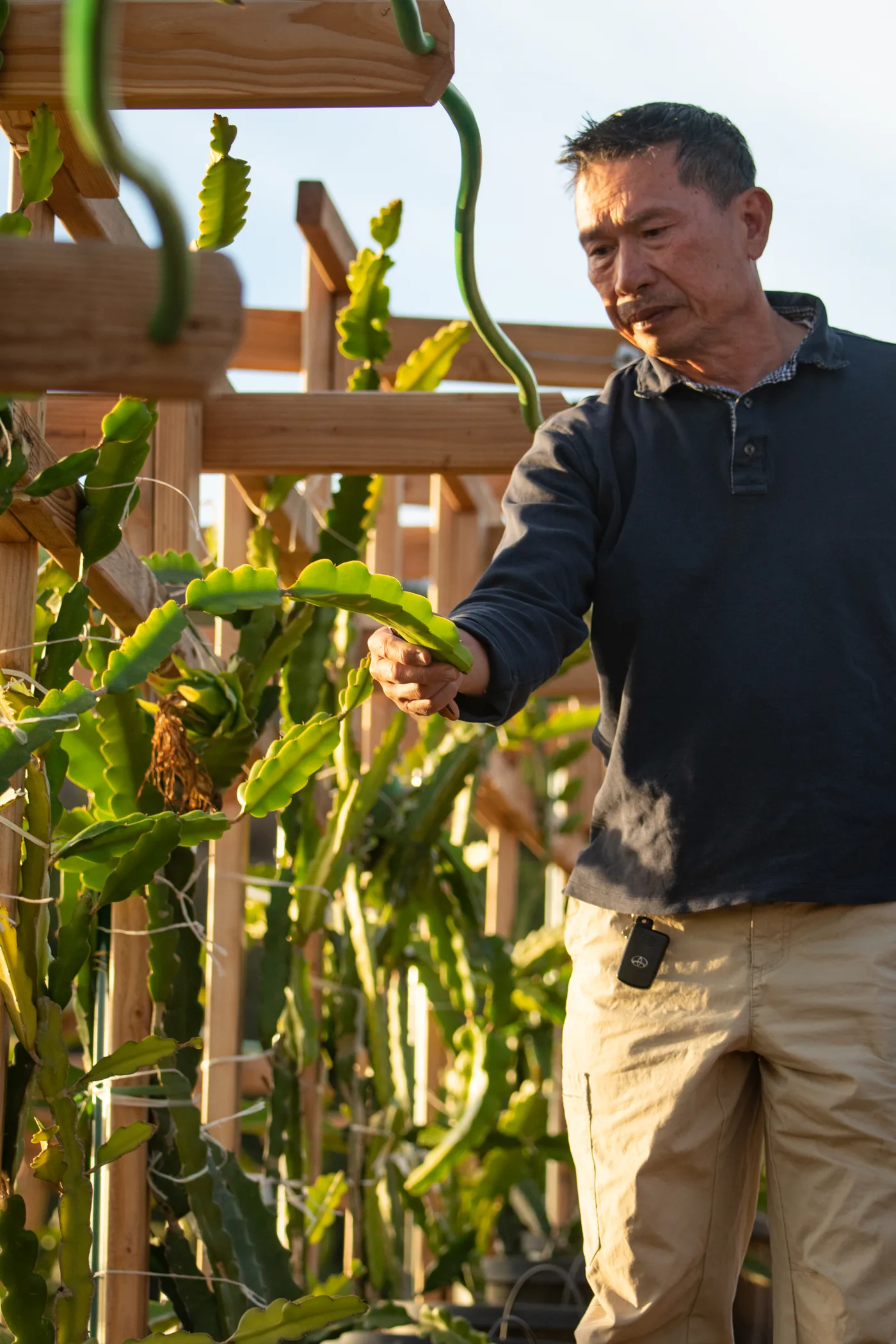
Good pruning is mostly a matter of looking before you cut, so walk the whole plant first.
Pests
Mites, thrips, ants, scales, bugs, mealybugs and slugs are the insect and mollusk pests listed in the extension sources, with beetles, borers and fruit flies added by another. Raccoons, opossums, rats and birds can damage fruit and plants. Check your plants whenever you water, all year, and contact your local extension agent for current control recommendations, since the right product depends on where you live.
Diseases
Fungal and bacterial problems are the major cause of loss. The ones named in the sources are stem and fruit canker, fruit and stem rot, anthracnose, and a bacterial stem rot caused by Xanthomonas campestris. Prune for light and airflow so the canopy dries quickly after rain, keep the soil well drained, and avoid wetting the stems with a sprinkler.
Harvest and Storage
When to harvest
Fruit is ready about 30 to 50 days after flowering, in late summer to autumn in most climates. In a warm subtropical climate the ripening season can run from June to November. How do you know a fruit is ripe? The skin has reached its full color, and that is the only fruit to harvest.
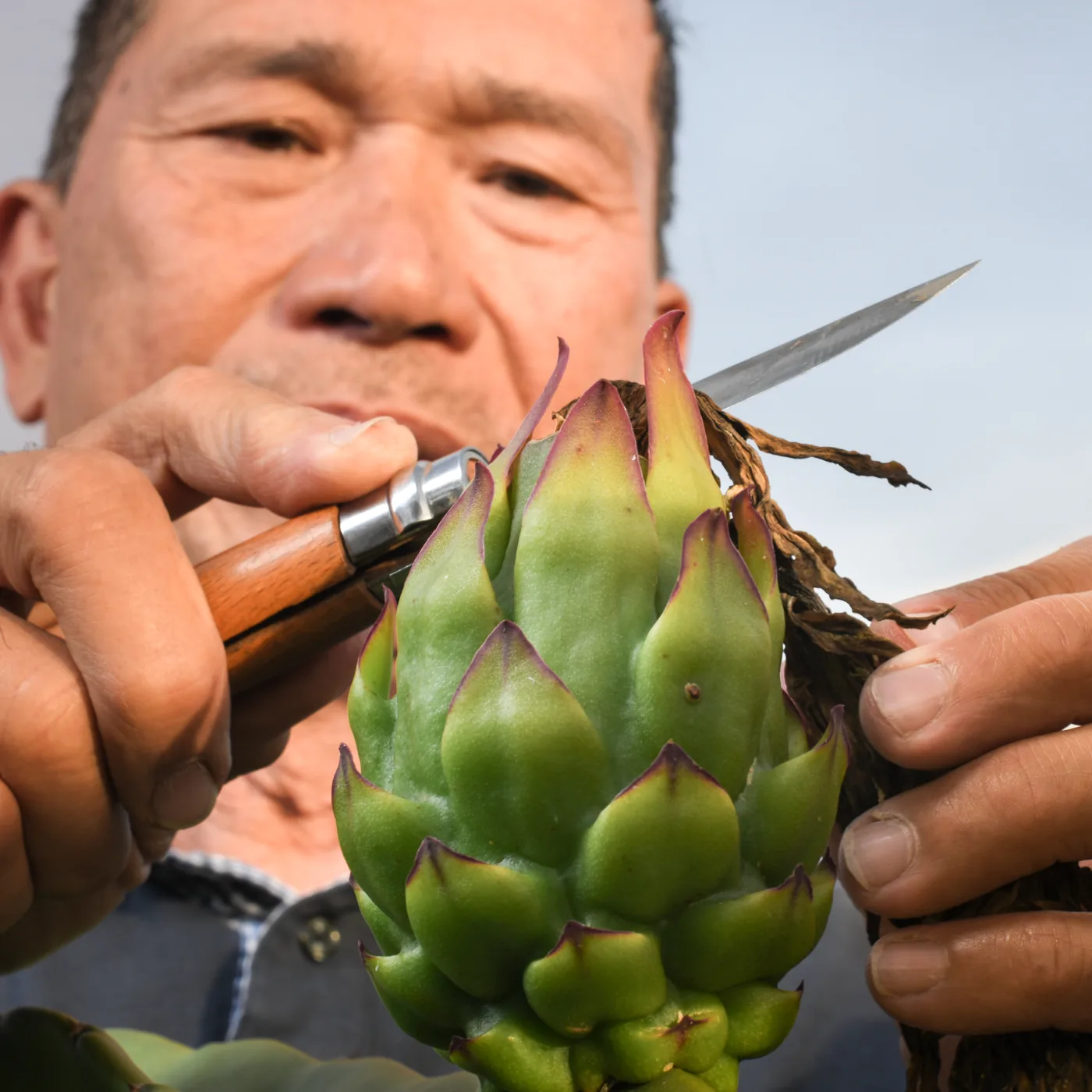
Use hand shears and cut the stem flush with the surface of the fruit so the cut does not damage the fruit or its neighbors. Wear leather gloves and long sleeves, because the stems are spiny.
How much to expect
A plant 3 to 4 years old can produce about 220 pounds (100 kg) of fruit per year, and a plant lives about 20 years. Commercial yields run 20 to 30 metric tons per hectare. Will your plant start there? No, because yield builds up year by year as the stems multiply.
Storage
Ripe fruit keeps 4 to 5 days at room temperature, or several weeks in plastic bags in the refrigerator. Plan to eat or process what you harvest within 4 to 5 days, and keep the rest cold.
Nutrition and Uses of the Fruit
The fruit is eaten fresh, halved and scooped with a spoon, or blended into juice and smoothies. The juice colors drinks and pastries. The flowers can be eaten as a vegetable or steeped as a tea, and the unopened flower buds can be cooked and eaten.
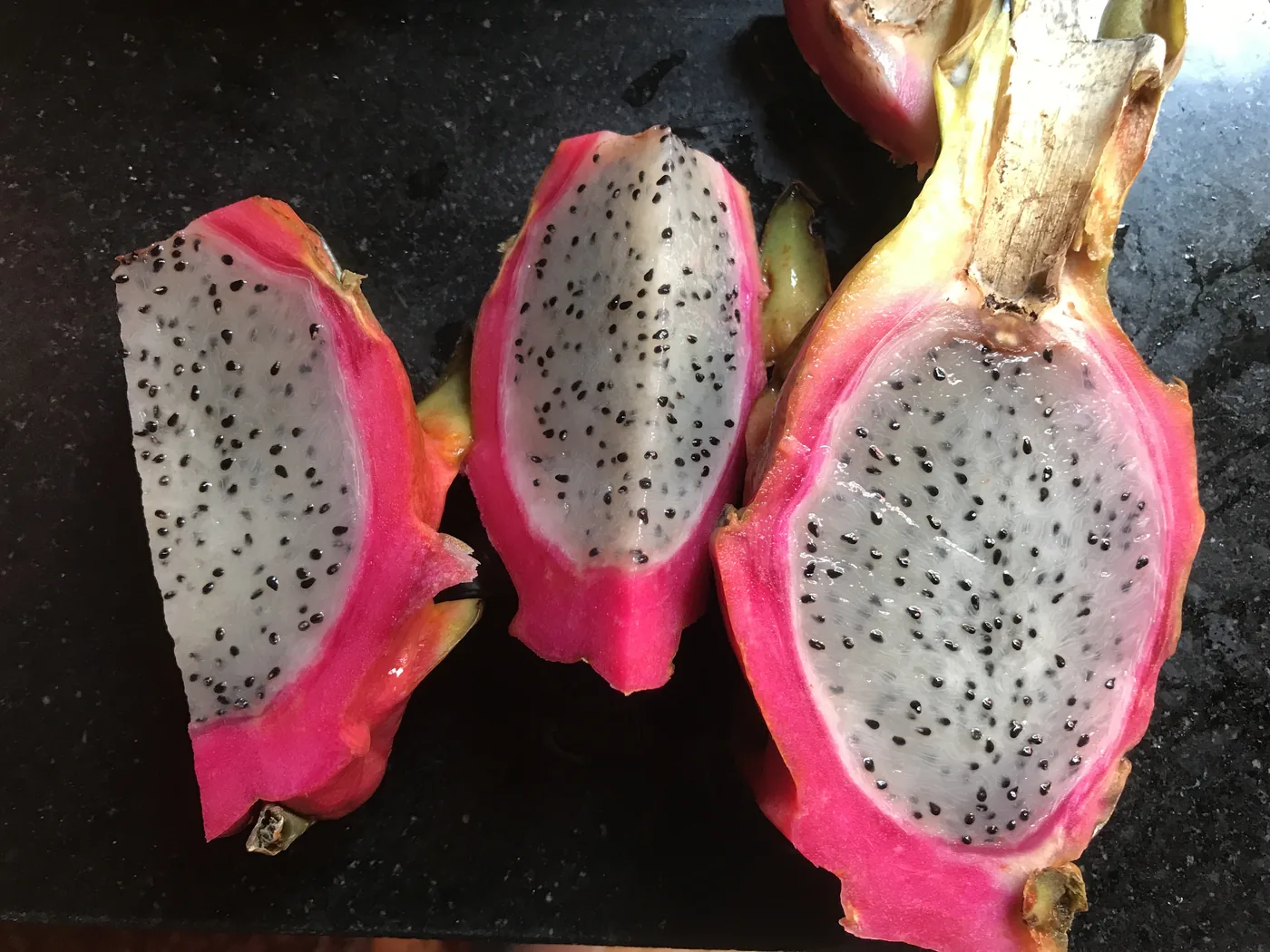
Per 100 grams of raw fruit, the nutrition looks like this.
| Nutrient | Per 100 g |
|---|---|
| Energy | 57 kcal |
| Water | 84 g |
| Carbohydrate | 15.2 g (sugars 9.75 g, fiber 3.1 g) |
| Protein | 0.36 g |
| Fat | 0.14 g |
| Vitamin C | 4.3 mg |
| Potassium | 116 mg |
No micronutrient is present in a significant amount, so enjoy the fruit for its taste and texture rather than as a vitamin source. The seeds carry oil, and the seed oil of this species is about 22 percent oleic acid and about 50 percent linoleic acid. Our partner website, purestextracts.com, covers what is known about the pigment, the peel and the seeds.
The plant has been used in traditional remedies for anemia, but the source that mentions it notes that this is not medical guidance. Another source lists no known medicinal uses. A trial of a powder made from the fruit found small improvements in how well blood vessels widen in healthy adults, and it found no change in blood pressure, so treat the fruit as food and nothing more.
Passionflower Cultivation Guide
Complete guide to passionflower and passionfruit cultivation covering Passiflora edulis and incarnata, growing parameters.
For a More In-Depth Read, Click HereSafety
Most of the risk in this plant is physical, and the rest is a short list of health cautions. The sap is caustic and the spines are sharp, so protect your hands and eyes when you cut or move stems.
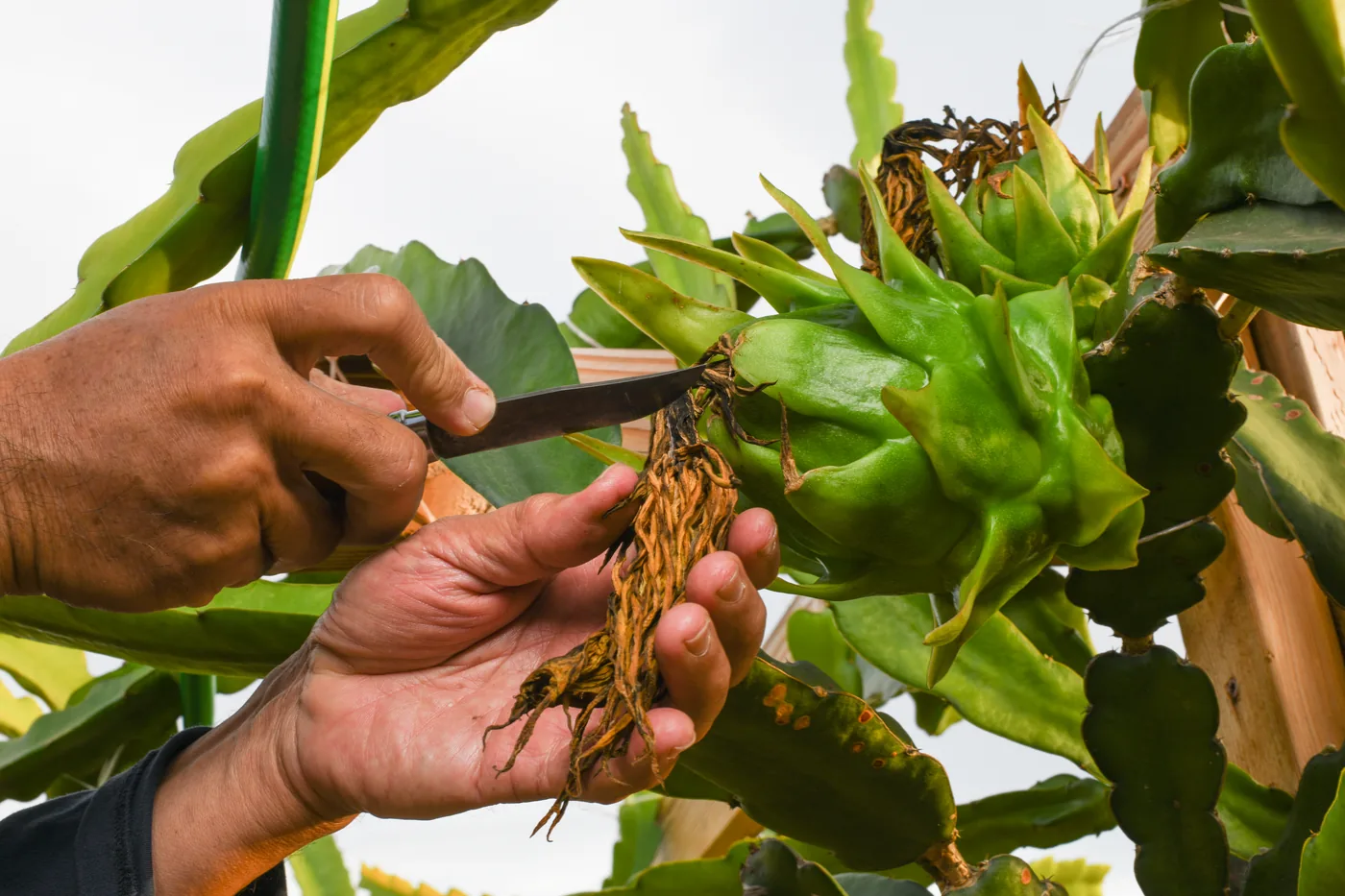
Two short lists follow, one for what to do and one for what to avoid.
What to do
Handle the plant and the fruit with care, and follow these steps each time you work on it.
- Wear leather gloves, long sleeves and eye protection when you prune, tie or harvest.
- Use clean, sharp tools, and wipe them between plants to avoid spreading disease.
- Try a small piece of fruit first if you have never eaten it, because allergic reactions have been reported.
- Talk to your doctor before you make the fruit a daily food if you take blood pressure medicine or a drug that lowers blood sugar, since one extension source says the fruit may interact with these.
- Stop and get medical help at once if you notice hives, swelling of the mouth or tongue, vomiting or trouble breathing after eating it.
A case report described a 26-year-old man with no history of allergies who had anaphylaxis, a severe, life-threatening allergic reaction, after eating dragon fruit. The authors point out that the allergy occurred without any cross-reaction to other foods, so a clean record with other fruit does not guarantee safety.
What not to do
These are the mistakes that cause injuries and failures in a home planting.
- Do not use bare cable or wire as a trellis, because it cuts the stems.
- Do not plant where standing water collects, because root rot follows.
- Do not touch the sap with bare skin or rub your eyes while you work.
- Do not feed or water heavily in winter, since a dry period supports flowering.
- Do not release stems into the wild or dump prunings outdoors, because the plant is classed as invasive in some places.
The plant is tagged as non-toxic to cats, dogs and horses, but the spines can injure any animal, so keep pets out of the planting.
Complete guide to turmeric cultivation covering Curcuma longa rhizome propagation, tropical growing requirements, curcumin extraction.
For a More In-Depth Read, Click HereCommon Questions
These are the questions growers ask most often, answered in the order they tend to come up.
Each answer below is short, and the sections above give the detail behind it.
How long until it fruits?
From a healthy cutting, many plants fruit 6 to 9 months after planting, and fruiting often begins within 1 to 3 years. From seed it can take up to 7 years, which is why almost everyone starts with a cutting.
Can you grow it in a pot?
Yes. It does well in a container, as a houseplant or on a patio, as long as the pot drains and you give it a trellis or arbor. Repot every 2 to 3 years or when it outgrows the pot.
Do you need two plants?
For good fruit, yes. Several cultivars are self-incompatible, so plant two or three different genetic types, not copies of one plant, and pollinate by hand.
Why did the flowers drop?
Overwatering and heavy rain are the usual causes of flower drop. Cut back on irrigation, especially in winter, and keep the soil drained.
How cold is too cold?
A long freeze below -1 °C (31 °F) (-2 °C) causes damage. Short frosts are survivable, and plants recover quickly from light freeze injury.
Why is my plant healthy but fruitless?
Check the pollination first, since a single plant or a flower missed on its one night will not set fruit. Check the light next, because fewer than 6 hours of direct light lowers production.
Is the fruit safe to eat?
For most people, yes. Some people are allergic, and the fruit may interact with blood pressure and blood sugar medicines, so read the safety section and ask your doctor if you take either.
Making Extracts From the Fruit
If you grow enough fruit to have some left over, you can turn the pulp, peel and seeds into juice, pigment and oil. The temperatures, the acid level and the equipment matter, and the extraction guide on our partner website covers each one.
Fruit harvested at its peak gives the best results in the kitchen and in the jar, so harvest on time.
Our partner website, Pure Extracts
Dragon Fruit (Selenicereus undatus) Extraction Guide: Juice, Peel Pigment and Seed Oil
Make dragon fruit extracts: peel pigment in water or 50 percent ethanol, juice, cold-pressed seed oil, color stability by pH.
References
- University of California Agriculture and Natural Resources, San Diego small farms, Pitahaya or Dragon Fruit Variety Evaluation Chart: cold hardiness, heat tolerance, sugar and market weight per plant for about 20 types.
- The reported color formation mechanism in pitaya fruit is inconsistent, PMC: betacyanins in red and white pulp and peel.
- University of Florida IFAS Extension, Dragon Fruit (Pitaya) Home Garden Facts: cuttings, planting, trellis, pollination, fertilizer, pruning, pests, harvest.
- North Carolina State Extension, Plant Toolbox: Selenicereus undatus, zones, light, soil, flowers, fruit, hazards.
- Plants For A Future, Hylocereus undatus: pH, temperature, rainfall, propagation, harvest timing and hazards.
- Wikipedia, Pitaya: species, fruit, flowers, cultivation, nutrition per 100 g, seed oil.
- Growables, Pitaya, Dragon Fruit: shade, support, flowering timing, pollination, yield.
- Betalain-rich dragon fruit (pitaya) consumption improves vascular function in men and women, American Journal of Clinical Nutrition (2022).
- Pitaya allergy: a case report of anaphylaxis in a patient without cross-reactive allergens, Allergy, Asthma and Clinical Immunology (2025).
- The reported color formation mechanism in pitaya fruit is inconsistent, PMC: white pulp of H. undatus and betalains.
Research on dragon fruit
Peer reviewed studies about dragon fruit, listed so you can read the original rather than take our word for it. They are background on the subject, not a source for any one sentence above.
- Oligosaccharides of pitaya (dragon fruit) flesh and their prebiotic properties (2009). doi:10.1016/j.foodchem.2009.11.026
- Proximate Analysis of Dragon Fruit (Hylecereus polyhizus) (2009). doi:10.3844/ajassp.2009.1341.1346
- Chemical composition and in vitroevaluation of the cytotoxic and antioxidant activities of supercritical carbon dioxide extracts of pitaya (dragon fruit) peel (2014). doi:10.1186/1752-153x-8-1
- Biochemical and nutritional characterization of dragon fruit (Hylocereus species) (2021). doi:10.1016/j.foodchem.2021.129426
- Essential fatty acids of pitaya (dragon fruit) seed oil (2008). doi:10.1016/j.foodchem.2008.09.108
- Roadmap post harvest loss reduction in selected Vietnamese value chains : Phase 1 : hotspots and feasible interventions in dragon fruit and longan (2021). doi:10.18174/548408
- New Products, New Markets: Dragon Fruit in Ecuador (2022). doi:10.18235/0003964
- Effect of selected solvents used in dragon fruit, pandan leaves and butterfly pea extractions on the color stability (2014). read the study
Common questions
What is dragon fruit?
A dragon fruit plant is a climbing cactus that opens enormous white flowers for a single night and then, a month or so later, hands you a pink fruit the size of your fist or bigger. You root a piece of stem, give it something tall to climb, keep it out of soggy ground, and wait for the buds. Nothing about it is difficult, but almost every step has a number attached that decides whether you get fruit in one year or never. The plant in this guide is Selenicereus undatus , the common white-fleshed dragon fruit, also sold as pitaya or pitahaya and still listed under its older name Hylocereus undatus in many references.
How do I grow dragon fruit?
This is a perennial, drought-resistant cactus. There is none, and there are no leaves in the usual sense. What you see are long, green, three-winged stems with scalloped edges that climb by sending out small roots from the stem itself, and the stems can reach 33 feet (10 m) in length. Each stem is 1 to 2 inches wide, and short gray-brown spines up to 0.4 inch (1 cm) long sit along the edges. On a post, a plant normally stands 8 to 20 feet tall and 3 to 10 feet wide, and its growth rate is rapid.
What are the conditions it wants?
This plant belongs in warm, bright places. It is rated for USDA hardiness zones 10 to 11, and it may survive outdoors in zone 9 if you give it protection. It tolerates heat up to about 100 °F (38 °C), and it grows best between 65 and 25 °C (77 °F) (18 to 25 °C). At what temperature does damage start? A long freeze below -1 °C (31 °F) (-2 °C) damages the stems, although a light freeze injures them only briefly and plants recover quickly.
How do I propagate dragon fruit?
This plant is grown for two different crops, the fruit and the stem cuttings that make new plants, and the work that raises one is not the same as the work that raises the other. Both start with a plant that is strong and in the right place. Fruit follows light, so give the plant full sun, at least 6 hours a day, and well-drained soil. Water at least once a week through flowering and fruiting, hold water back in winter, because a dry period helps flowering, and feed on the schedule in the water and feeding section. A crowded plant shades its own stems, and shaded stems carry little fruit.
How much water does dragon fruit need?
Does a cactus need regular water? This one does, because it is not a desert plant that wants to be left alone. Water the plant when the soil is almost completely dry, and water generously in spring and summer through the end of flowering. Irrigate at least once a week during flowering and fruiting, since the fruit is mostly water. In winter and early spring, hold back.
What pests and diseases affect dragon fruit?
How often should you prune? Prune 1 to 3 times a year, ideally once the harvest ends. Cut out damaged, diseased or dead stems, and any stem that reaches the ground. Selective removal also improves vigor and promotes flowering. Dip each cut in fungicide to cut down on stem rot, use clean tools, and carry the pruned stems out of the planting area.
When should I harvest dragon fruit?
Fruit is ready about 30 to 50 days after flowering, in late summer to autumn in most climates. In a warm subtropical climate the ripening season can run from June to November. How do you know a fruit is ripe? The skin has reached its full color, and that is the only fruit to harvest. Use hand shears and cut the stem flush with the surface of the fruit so the cut does not damage the fruit or its neighbors.
Is dragon fruit safe?
Most of the risk in this plant is physical, and the rest is a short list of health cautions. The sap is caustic and the spines are sharp, so protect your hands and eyes when you cut or move stems. Two short lists follow, one for what to do and one for what to avoid. Handle the plant and the fruit with care, and follow these steps each time you work on it. Wear leather gloves, long sleeves and eye protection when you prune, tie or harvest.
How do I extract dragon fruit?
If you grow enough fruit to have some left over, you can turn the pulp, peel and seeds into juice, pigment and oil. The temperatures, the acid level and the equipment matter, and the extraction guide on our partner website covers each one. Fruit harvested at its peak gives the best results in the kitchen and in the jar, so harvest on time.
What is research on dragon fruit?
Peer reviewed studies about dragon fruit, listed so you can read the original rather than take our word for it. They are background on the subject, not a source for any one sentence above. Oligosaccharides of pitaya (dragon fruit) flesh and their prebiotic properties (2009); doi:10.1016/j.foodchem.2009.11.026 . Proximate Analysis of Dragon Fruit (Hylecereus polyhizus) (2009).
Browse by topic
More guides to explore
 GrowingChamomile Cultivation Guide
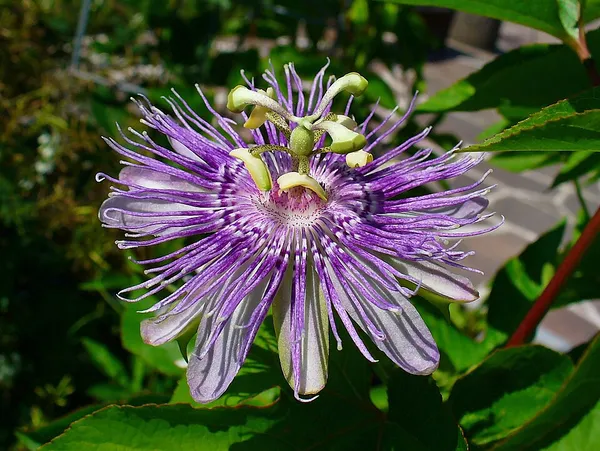 GrowingPassionflower Cultivation Guide
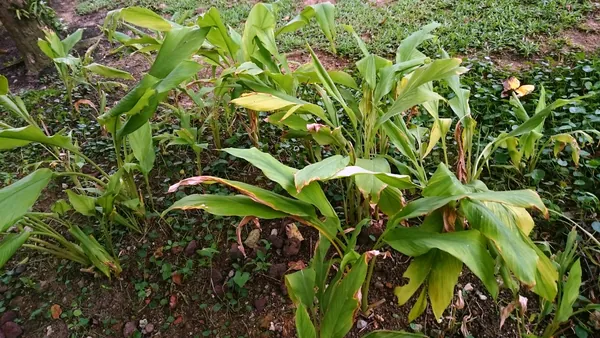 GrowingTurmeric Cultivation Guide
 ExtractionSteam Distillation
 GrowingGoji Berry (Lycium barbarum) Guide
 GrowingCats Claw Cultivation Guide
 GrowingFig (Ficus carica) Guide
 GrowingSanta Rosa Plum Cultivation Guide
 GrowingAgarita Cultivation Guide
 GrowingAloe Vera Cultivation Guide
 GrowingAshwagandha Cultivation Guide
 GrowingBacopa Monnieri Cultivation Guide